
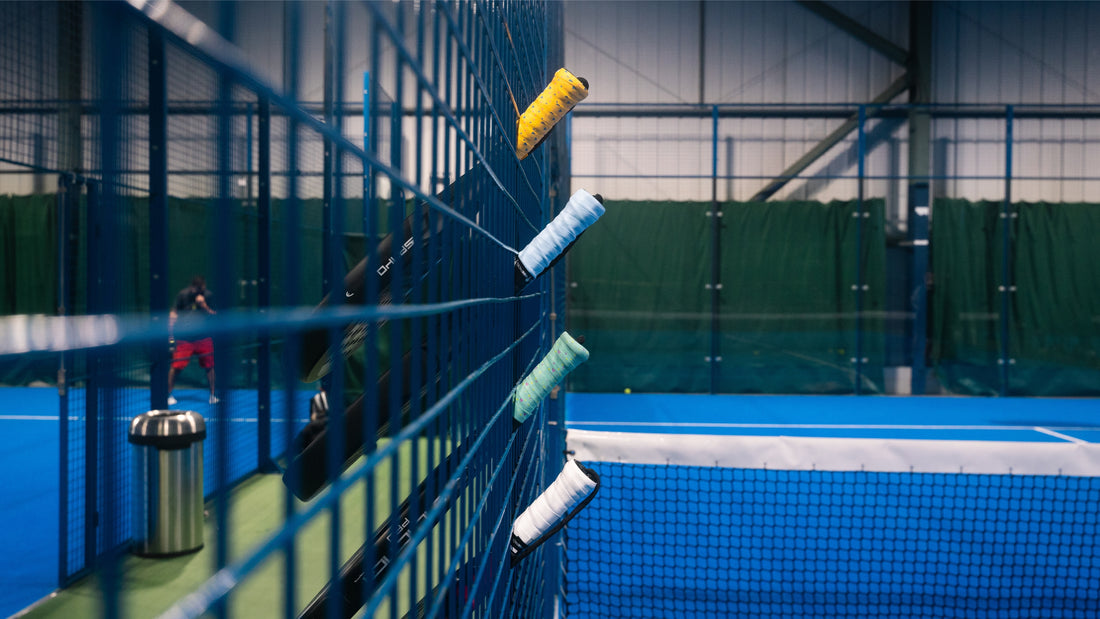
Decoding Padel Overgrips: An Essential Guide by VIBEPADEL
Share
In padel, most players spend weeks choosing a racket and about ten seconds thinking about what goes on the handle. But the overgrip is the only part of your racket you actually touch. It decides whether the racket twists in your hand on a volley, whether your palm is slipping by the third set, and how much feel you get on a bandeja or vibora.
This guide breaks down what padel overgrips are made of, how they differ, and how to choose the right one for your game.
What is a padel overgrip made of?
Almost every overgrip on the market is built from one or both of two materials:
Polyurethane (PU) – the soft, slightly tacky surface you feel in your hand. PU is what gives an overgrip its grip and cushioning.
Non-woven microfibre – a fabric layer that soaks up sweat, keeping your hand dry as matches heat up.
PU on its own grips well but can get slippery once you start sweating. Microfibre on its own stays dry but can feel harsh and less secure. The best overgrips combine the two.
Single-layer vs multi-layer overgrips
Single-layer overgrips are the most common because they're cheap and simple to make. They do the job, but they tend to lose their tackiness quickly and offer little cushioning.
Multi-layer overgrips blend PU and microfibre into one strip. They're harder to manufacture, but you get grip, comfort and sweat control in the same wrap – and they usually last longer before they need changing.
Does overgrip thickness matter?
Yes. Overgrips typically range from around 0.4mm to 0.8mm. Thicker grips last longer and add cushioning, but they also build up the handle size and can dull the feel you get from the ball. Thinner grips give a sharper connection with the racket but wear faster. If your racket handle already feels chunky, go thinner; if you want more comfort and durability, go thicker.
Why tennis overgrips aren't ideal for padel
A lot of “padel overgrips” are really tennis overgrips in different packaging. A tennis handle is much longer than a padel handle, so a tennis-length grip leaves you with a long tail to cut off and throw away. It works, but it's wasteful and fiddly, and it's a sign the product wasn't designed with padel in mind. A padel-specific overgrip is cut to the right length, so you wrap it, tape it and play.
Tacky, dry or all-round: which type should you choose?
Tacky overgrips
Sticky to the touch and give the most secure hold. Best for players who like a locked-in feel on volleys and smashes.
Dry overgrips
Built to absorb moisture. Best for very humid conditions or players who sweat heavily, though they tend to need replacing more often.
All-round overgrips
Start tacky and gradually become drier as they're used. A good middle ground for most club players.
Conditions matter too. The grip that feels perfect on a cold indoor evening can feel very different in a sweaty summer session outdoors, so it's worth having a few spares in your bag. (If you play through the winter, our guide to adapting your padel game to cold conditions has more tips.)
How often should you change your overgrip?
A simple rule: change your overgrip as many times a month as you play a week. Play twice a week, change it twice a month. If it looks shiny, feels smooth or has started to fray, it's done. We cover this in more detail in Why use an overgrip?
Introducing the VIBEPADEL Grip 'n' Rip overgrip
We designed the Grip 'n' Rip padel overgrip around everything above:
3-layer construction – a tacky PU top layer for grip, a non-woven microfibre middle layer for sweat absorption, and a PU base layer that holds firm on the handle.
Super tacky, non-slip – the top layer gets tackier as you play, ideal for shots like the vibora where the racket can't move in your hand.
Comfort – extra cushioning you'll notice on controlled shots and long rallies.
Padel length – no cutting, no waste. Wrap it and go.
Your colour – from classic All White and All Black to the Mix it up and Retro packs.
Shop Grip 'n' Rip overgrips → 3-packs from £9.99. Buy any 3 packs and get £5 off plus free UK delivery.
Padel overgrip FAQs
Do I need an overgrip on a padel racket?
You don't have to, but it's strongly recommended. An overgrip protects the racket's base grip (which is fiddly and costly to replace), gives you a fresh, tacky feel whenever you want it, and lets you fine-tune the handle size.
Can I use a tennis overgrip on a padel racket?
Yes, but you'll usually need to cut it down to fit the shorter padel handle. A padel-specific overgrip fits without any trimming.
What's the difference between a grip and an overgrip?
The base grip (or replacement grip) is the thicker layer fitted to the handle by the manufacturer. An overgrip is a thinner layer wrapped on top, designed to be changed regularly.
Which overgrip is best for sweaty hands?
Look for one with a microfibre layer for absorption. A multi-layer grip like Grip 'n' Rip combines sweat absorption with a tacky surface, so you don't have to choose between the two.


